the best scale in nutrition isn’t the kind you step on
Have you come across a Hunger/Fullness Scale yet? This has to be one of the most useful tools in the nutrition counseling toolkit. I’ve used this scale for years to empower my clients and patients to manage blood sugar regulation, bloating, nausea, mild binge eating tendencies, energy levels, and more.
Usual disclaimer, though, if you have symptoms or health concerns, please see a qualified medical professional to address more factors than this! But in the meantime, this can be a helpful tool.
SOME BACKGROUND…
Understanding our own body’s language isn’t always as intuitive as it sounds. And that’s okay. It’s not impossible to relearn, or for some of us, learn for the first time.
We’re not always taught what hunger feels like outside of maybe the stomach rumbling. Often, we’re actually taught to ignore our hunger or to suppress it. Diet culture, jobs, medications, and stress (among other factors), interrupt our understanding of when the body is hungry. But, there is wisdom to hunger. More below on that. But first!
HOW TO USE A HUNGER/FULLNESS SCALE
There’s no single, perfect way to use this. It’s not a scale that requires precision. It’s a tool for pattern recognition. Whether we do or don’t feel hunger throughout the day is information. When we feel hunger is information. How full we feel after a meal is information. Once we have the info, we use it to strategize. This is a tool that takes time to work with. You can absolutely try it on your own, but, if you can, learning how to use this tool by working with a Registered Dietitian (RD/RDN) or Certified Nutrition Specialist (CNS) is ideal.
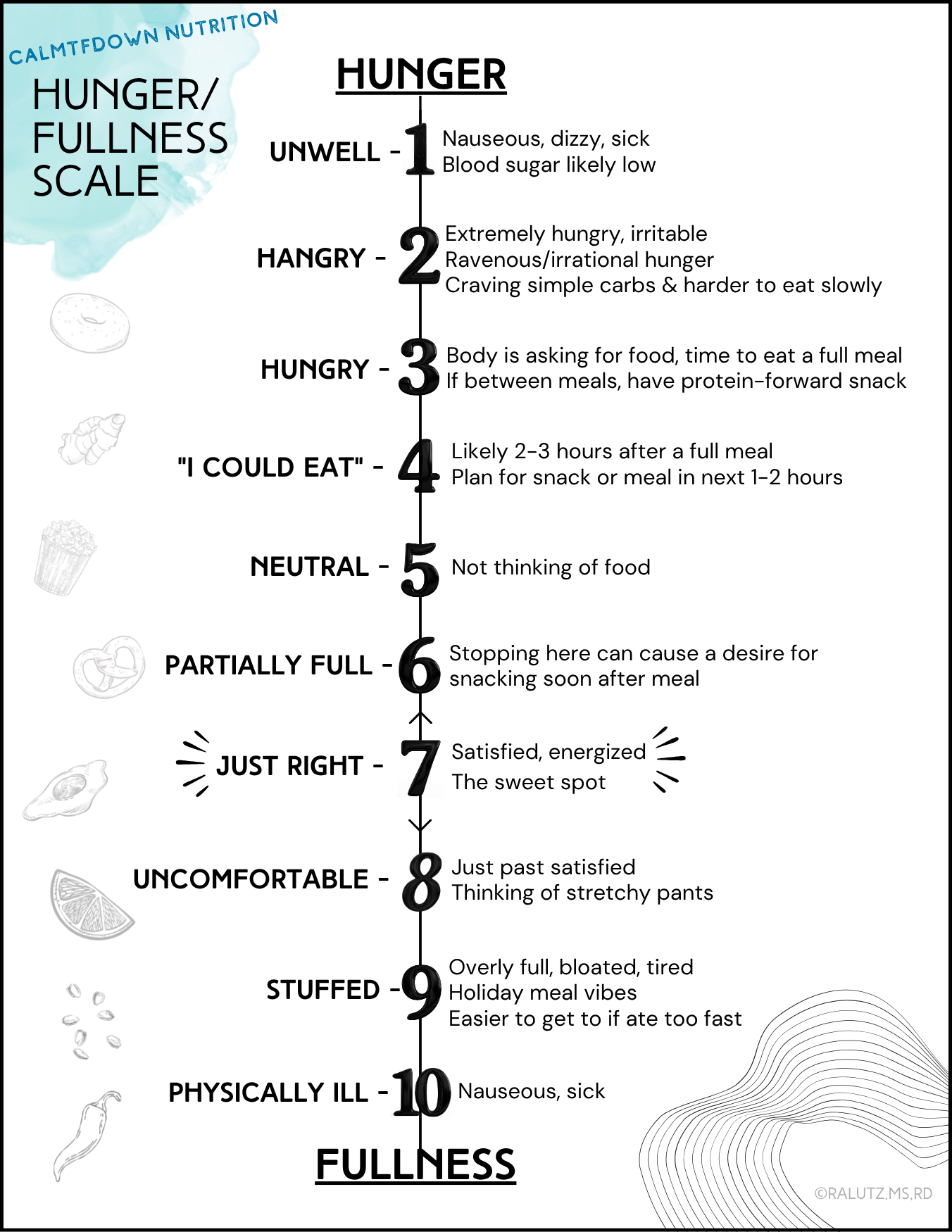
HUNGER (1-4)
If a car runs out of gas, it just stops. If the body runs out of fuel, it doesn’t just stop (well, for a while anyway).
Instead, our bodies will try to send us hunger signals.
The signals start quiet, a 4 on the scale (thoughts that keep going back to food), by 3 they get louder (stomach rumbling, cravings for any food), and at 2 even louder (head ache, cravings for simple carbs, lower energy), and by 1 on the scale, we’re at the loudest hunger signal the body can send (shaking, sweating, nausea, dizziness, even passing out).
The hungrier the body gets, the less work the digestive system wants to do for its energy. Ever get to a meal so hungry you feel like you need to slam back the bread, rice, pasta, or other carby food? That’s a 2 on the scale. This isn’t because we’re some out of control carb fiend, it’s because we got too hungry before the meal and the body started to demand fast energy as fast as possible.
At the point of 1, it might seem backwards that we could feel nauseous. Who wants to eat when nauseous? That’s not the time for a complex food item. Try for something easy to digest or, if you have diabetes or another type of blood sugar concern, speak with your health care provider about an amount of fast glucose to have on hand.
NEUTRAL & PARTIALLY FULL (5-6)
At neutral, we’re just living life, coasting on the fuel we took in an hour and some change ago. Partially full, number 6 on the scale, is helpful because if we end a meal not feeling full enough or we eat something that’s mostly carbs, we’ll end up back at a 4 or a 3 within 20-30 minutes. Not only is this annoying because we need to eat again, but it can be hard on things like blood sugar, energy levels, GI symptoms, and more.
FULLNESS (7-10)
Fullness is not only affected by what we’re eating, it’s also affected by how fast we eat.
At some point after we start eating, body will get ready to send messages/cues that we’re full, otherwise known as satiated. But these messages operate on a delay. It can take the body 10-20 minutes to signal that we’re full.
Think about it, if we slam back an entire plate of pasta in 5 minutes flat because we were so hungry, it’s easier to pass up how much the body actually wanted. Next thing we know, we just went from a 2 to an 8 or even 9. That’s not only uncomfortable, but it’s a lot of work for the body to manage that all at once. If this turns into a pattern, it can aggravate symptoms and we’ll be taking in more food than the body really needs. Some people are told they’re gluten intolerant, but really, it might be a portion and speed situation.
If we eat at a reasonable pace, we’re likely to recognize when we’re getting properly full. This increases our chances of landing at a 7. This means the body is getting just enough energy, the digestive tract isn’t being overwhelmed, and we get to walk away from the table feeling energized instead of tired and generally bleh. If we’re getting too full too fast, time to speak to a health care provider.
For the record, it’s perfectly fine to get to an 8 or 9 sometimes. Sometimes we just want that extra bite or serving and that’s okay. We just want to be aware of how often this is happening. Nutrition is about patterns over time, not “perfection” all the time.
PATTERNS, MEALS, AND SNACKS
It can be easy to fall into a pattern of getting to a 2, then ending up at an 8 or 9, because we haven’t learned our body’s hunger and fullness cue and/or how to balance meals and snacks. This isn’t a comfortable way to live, though, and it can even affect our health.
Hunger, especially in the morning, can be quieted by factors like stress, medications, and caffeine. Many of my clients and patients (and me!) find it helpful to have at least some bites or sips of a protein-forward food or drink before caffeine to give the body a better chance of feeling hunger when it actually needs food in the afternoon.
I knowwww Intermittent Fasting is still so in right now. I’m not against it. Many bodies benefit from not eating 2-3 hours before bed and not eating while we’re sleeping. I just recommend flexibility with the morning fasting window, especially for people with a menstrual cycle, high stress, and/or health conditions. This is where individual counseling is crucial. If you have questions about this, try seeing a Registered Dietitian (RD/RDN) or Certified Nutrition Specialist (CNS) for more info.
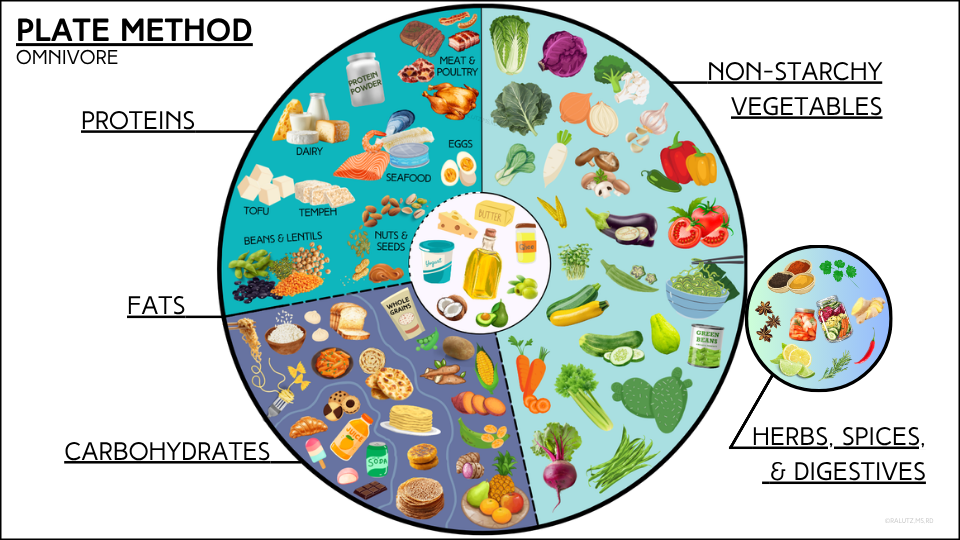
For snacks throughout the day, try to pair carby foods (crackers, chips, granola bars, etc.) with a source of protein and fats so they last longer. The other top nutrition tool, The Plate Method (pictured above), can be helpful for this. Here’s a link to my post on that.
For example, if we’re hungry at 3PM (at a 3 on the scale), but dinner isn’t until 7PM, and we grab some crackers to eat, the body will use those up and we’ll be hungry again maybe an hour later, if not sooner. But, if those crackers are paired with cheese or peanut butter, it will take a little longer to digest, so we’ll feel full longer. We get to stay at a 4 on the scale until dinner, then we’ll be less likely to eat dinner whole and get to an 8 or 9.
See what I mean? Patterns over time.
So, that’s the hunger/fullness scale. I’ve designed a bunch that you can find on my website and Instagram. Sometimes patients and clients will print it out or keep one handy on a phone, especially when it’s new. If you have more questions or want some more guidance on how to use this, click the ‘Book Now',’ button, and let’s talk. Thanks for your time! Good luck out there.