the plate method is the GOAT: a quick & dirty guide to meal balance
The Plate Method is the GOAT when it comes to nutrition tools. Seriously. In nutrition counseling, when we pair the Plate Method with the Hunger/Fullness Scale, we can go from taking baby steps to making strides in developing a sustainable, all-foods-fit, shame-free nutrition practice.
You might be wondering, “so, if I use this tool I’ll be healthy forever with the physical and functional body of my dreams?” Sorry toots, that’s not how health and nutrition have ever operated. There is no perfection, no control in nutrition and health. BUT, there is influence and patterns over time, and that is exactly where this tool is the most useful. I’m calling this essay the quick & dirty guide to meal balance because reading one essay and seeing a few examples of this tool doesn’t create lasting change, but this will be the tip of the iceberg if you’re curious.
BACKGROUND
Nutrition tools like the food triangles and pyramids of the 1980’s and 1990’s were too vague. Though they likely meant well, they ranged from inaccurate to unuseful at best. Also, these models were highly influenced by food industry lobbying, not by input from qualified nutrition professionals. As for the one that came out early 2026..I don’t have a single kind word to say about it, so I won’t say anything at all other than we can simply send that one to the depths of the oceans of our minds and move onto nutrition tools that make sense.
Cue: The Plate Method (nutrition nerds cheer and clap)
The Plate Method is thought to have come about in the 2000’s as a way to provide more specific guidance on portioning food meal by meal instead of vaguely indicating what we should eat in a day. In 2011, a version of the plate method titled My Plate finally replaced the outdated food pyramids thanks to efforts fro the USDA and Michelle Obama. Throughout my years in nutrition counseling, working with individuals from a variety of cultural and socioeconomic backgrounds with an even wider variety of health conditions and needs, I’ve found the Plate Method to be the most useful tool in the toolkit. I created a version that can be adapted to any cultural cuisine or budget. Here are the versions of The Plate Method I use in appointments with my patients and clients:
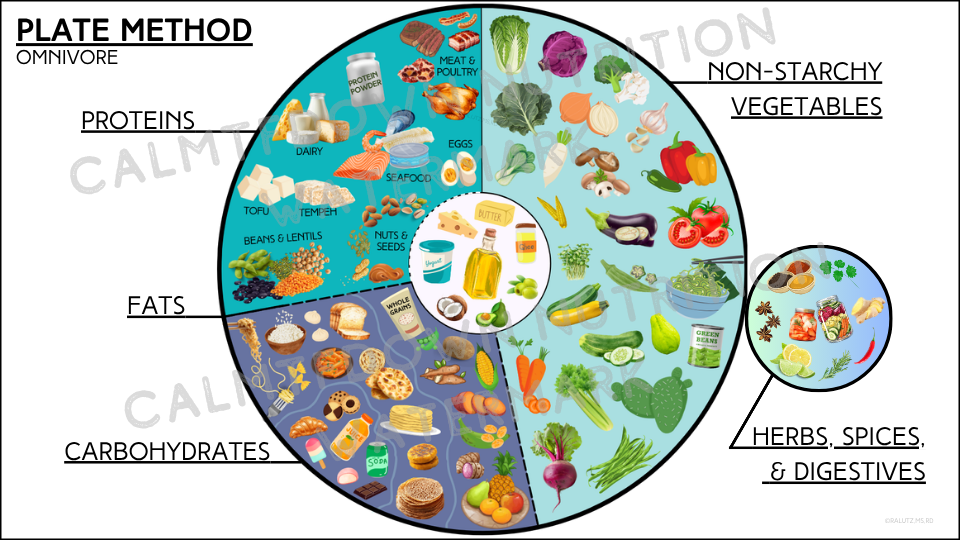
(Please excuse the watermarks. These are original designs available for professional and/or personal use. Email me for prices!)
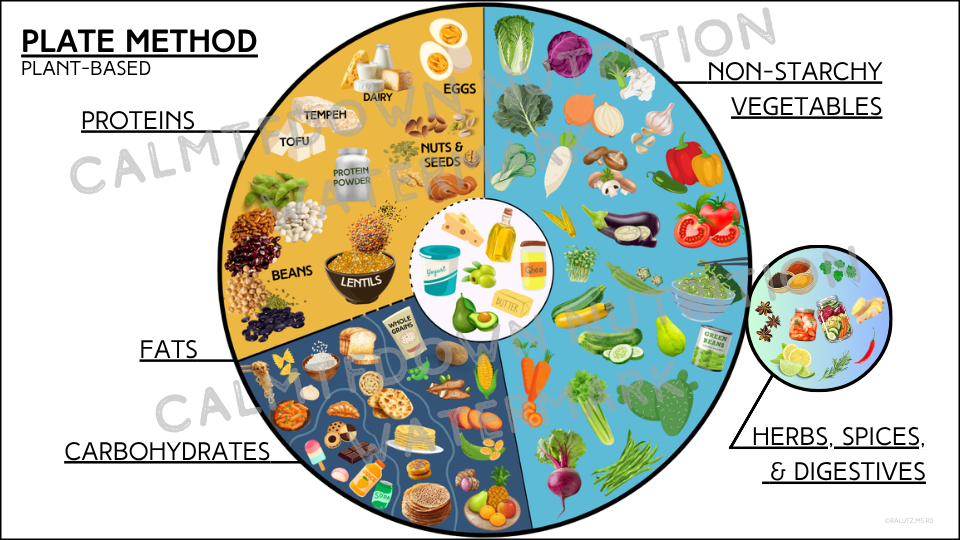
(Please excuse the watermarks. These are original designs available for professional and/or personal use. Email me for prices!)
HOW TO NOT USE THE PLATE METHOD
In appointments, I don’t pull this up and say, “Okay, now just make every meal and snack look like this and everything will be okay.” That would be unrealistic and, tbh, stressful.
HOW TO ACTUALLY USE THE PLATE METHOD
It’s not a prescriptive tool. It’s a guide for patterns over time. This is something we often take many appointments to unpack and individualize, depending on a person’s:
health conditions, physical abilities, relationship to food
budgets (financial and time budgets)
cooking preferences/skills
cultural ties
housing situations
health literacy
WHERE WE START
There are 5 categories:
Proteins
Carbohydrates
Fats
Non-starchy Vegetables
Herbs, spices, and digestives
I made a guide you’re welcome to purchase that expands on each of these categories, but for the sake of this post, I’ll keep it quick. If the guide is too expensive, email me. I give out discounts for qualifying considerations.
Anyway, It’s not necessary to think of any of these categories as ‘bad’ or ‘good.’ It’s also not necessary to only eat one or two of them all the time (lookin at you, carnivores) unless you are working with a trained healthcare provider because of a health condition.
PROTEIN
Doesn’t it feel like protein is in everything now? We’ve gone beyond protein bars to protein cereals, protein chips, protein ice cream, protein pants, protein pens. It’s not stopping. Tbh, I don’t mind it, because for some people it just makes it more possible to eat it, especially for snack. But, I do a lotttttt of work with people on figuring out about HOW MUCH and WHEN it’s most helpful in meals and snacks.
At the beginning of our work, a lot of people are usually under-doing protein in the morning, skipping it entirely for snacks, and going extra hard on it for dinner. Lately, I’ve had some people who are eating way too much of it, to the point of kidney damage. Protein is important, but it’s easy to under- or overdo. Seriously, please work with a Registered Dietitian (RD/RDN) or Certified Nutrition Specialist (CNS) on this. Reading one essay just isn’t enough to determine the best fit. I wish it were more simple, but it isn’t.
CARBOHYDRATES
Poor carbs. Their reputation is on a nonstop rollercoaster ride, decade by decade. By this decade, there are at least a dozen reasons that we end up being mean to carbs, but we don’t need to be. Carbs are important because they give our bodies faster energy than protein and fats. There are a few different types of carbs, complex and simple. Sorry to sound like a broken record, but my guide expands on this way more.
In short, going carb-free tends to be unsustainable and a sad time because carbs are delicious. Also, that can lead to a restrict/binge cycle fast. I work with a lot of people to figure out how to have all the tasty carbs in portions that make sense and without guilt or shame. It’s possible, I promise! Remember, nutrition is about patterns over time, not “perfect” meals all the time.
Also, it’s also important to get a handle on carbs because this is where most of our soluble fiber comes from, not non-starchy vegetables. Surprise! Non-starchy vegetables have mostly insoluble fiber, but carby foods like beans, fruit, nuts, and seeds are the undeniable fiber powerhouses. Fiber is important for feeling full, for blood sugar and cholesterol management, and for having good poops. Low/no carbs means low/no fun, fiber, or fulfilling BMs.
FATS
Fats take the body a lot of time and effort to digest. They’re important to have in a meal because they help with things like energy, skin health, hormones, cholesterol support, and more. But, if we have too much, we’ll feel sluggish, overly full, and sometimes even feel some nausea.
Ever go too hard at a fair or fast food joint and feel like your soul is tired afterward? Our bodies need so much energy to break down fats, we’ll usually feel sluggish while bodies get this done. Figuring out how much to have and when can be challenging
VEGETABLES
If you have the time, energy, and ability to make them taste good, the non-starchy vegetables are helpful for a couple reasons. First, they can be a delicious addition to the meal if they’re made well. Sometimes we think we don’t like vegetables, but we actually don’t like vegetables that don’t taste good. Second, they provide VOLUME without ENERGY. They can help us feel full, but not for a long time because the body doesn’t break them down for energy. This is why eating a pile of leaves on their own or filling up on only broccoli isn’t a great idea for a meal..or even a snack. But, if we have them as a significant portion of the meal, it helps prevent feeling sluggish and tired after. Bonus!
HERBS, SPICES, AND DIGESTIVES
This is my favorite category. This is where we get flavor and some help with digestion. Again, I expand way more on this in my guide, but in short, the bitter and sour flavors in this category support the digestive tract by telling it to make more of the chemicals that break food down. Cultural cuisines around the world incorporate these flavors often before, during, and sometimes after a meal. Whether we’re thinking fermented foods, digestive beverages, or herbs and spices, this is the category that keeps giving.
So, that’s the quick and dirty Plate Method crash course. As usual, it’s a tool that tends to benefit from individualizing, diving into unpacking each category, and remembering that nutrition isn’t a game of perfection. It’s a game of influence over time. If you think this could be helpful in your life and you want some assistance with it, let’s work together. Thanks for your time!